Saturday, September 18, 2010

Cross country in Japan

Finally I could take a long break and travel across Japan: Tohoku, Hokkaido, Chugoku, and Kyushu districts.
Earlier I'd been around Kanto, so gave that a skip, along with neighboring district of Kinki (yes! there is a district by that name, and a University! 'think would be fun to say "'am a kinki graduate")


Japan is a splendidly beautiful country, be it cities or countryside. Of the most safest, and convenient, places for backpacking.


Day 1
Started from Tokyo, took a train to Akita (there are multiple options, fastest of which is Shinkansen -- bullet train, which is most expensive as well). There are also night trains, with budget sleeper compartments (goron to shito) and carpet-compartments (Nobinobi). Akebono runs from Ueno to Aomori (stops at Akita), Moonlight echigo runs from Shinjuku to Niigata.

I was armed with a Hokkaido & Higashinihon pass, which allowed use of all rapid and regular trains all the way to Hokkaido and then within Hokkaido too. It is a steal at $100, but the downside is that many super-fasts and bullet-trains don't allow a ride with a top-up on this pass (i.e. you have to get a complete-fare ticket)


Aoike (blue pond) is close to Akita, in the mountains of Shirakami-sanchi -- a world heritage area. The surreal blue and clear water looked beautiful with sun streaming in through the forest around.


Day 2
Very memorable was the leg between Akita and Aomori on Gono-sen. This train line runs adjacent to the sea of Japan most of the time. If you are riding Gono-line in late afternoon time, take the Shirakami resort train. Its plush seats, extra-large windows and in-house live local music is the most romantic setup for watching the sun go down into the ocean! Even the day time ride that I took on this was totally worth the extra fare!
This European castle style building is a restaurant near one of the stations on gono-line -- Wespa Tsubakiyama. Furofushi hot-spring is ~2kms from here. Great place to take a dip in mud-water while watching the sun set into sea of Japan.


Day 3
After resting in Moya Hills (excellent night view of Aomori city), took a train from Aomori to Shimokita and then a bus from Shimokita to Mt. Osore-zan.

Osore-zan, it is believed by locals, is the place where souls of dead gather. Very picturesque place with mountains all around and a huge pond in the center, with a clean stretch of white-sand beach!
There are small suphuric ponds (known as "hells") around due to which smell of sulphur is pervasive. 
Shimokita-hanto peninsula is close to this place, and is the northernmost tip of Honshu. Mountains around looked ideal for a hike, but I was eager to get to Hokkaido and pressed on!
If you are in Aomori during first week of August, enjoy the local flavors in Nebuta festival parade. 


Day 4
Hamanasu express is a night train between Aomori and Sapporo (Hokkaido). The Hokkaido pass is accepted in this train, with a small charge for reserving the seat. Hokkaido is big! Specially so if you are taking the regular trains from one place to another.

Asamushi onsen is close to Aomori (~30mins by train). There are many hot-springs here with a good ocean view. This small hill/island in near Asamushi onsen station.


Day 5
Went on to south-east Hokkaido, to Abashiri. Abashiri is the largest town on Okhotsk coast. Proximity to Russia (and early Russian influence) is evident in all the town signboards, which is written in Japanese and Russian. Abashiri prison is out of use now (except for tourism). A beautiful backdrop of mountains and looks more of a vacation place that a place to be sentenced at!
 
A small station on the way from Abashiri to Kushiro.


Day 6
Kushiro wetlands -- miles and miles of greenery, with only the Kushiro river cutting through. Sitting at this viewpoint for few moments takes away all the fatigue of hike!


Crabs in Kushiro market. Near to Kushiro station, in this supermarket you can make your own sashimi-donburi (fresh fish with rice-bowl). Hokkaido dairy, fish and other foods too is delicious!


Day 7
Nemuro, on the east coast of Hokkaido. Earliest sunrise in Japan is said to be here! I couldn't go, but heard that cape Nosappu has got a splendid view. Also has Japan's oldest lighthouse. 

Public conveyance is sparse as you go towards the interiors in Hokkaido. Having your car (or rental) is helpful.
Before dawn, a lighthouse in Nemuro.


Day 8
Flower farms in Biei. Biei and Furano are in central Hokkaido. Farms here are maintained so primly that you would think that farmers are spending more time on decoration than on produce.. guided tours from Biei station are recommended than venturing out on your own, unless you are driving

Day 9
Otaru. On western coast of Hokkaido. Kamome birds following the launch which I took from Otaru to Otamoi coast. They were a delight to watch, specially when catching food mid-air (thrown by kids in the boat).


Otamoi coast has got beautiful rock formations on sea. The area around is nice for hiking and camping.

Otaru Canal


Day 10
Sapporo. This is the garden of Hokkaido University. Japanese landscaping at its best!

Day 11
A visit there isn't complete without going to the Sapporo beer factory.
Did you know that Sapporo, Yebisu and Asahi beers were being brewed by the same company? Got split into separate companies due to antitrust laws after WW II.

Return from Sapporo to Tokyo was by air. Check out AirDo and Skymark airways in that sector for budget fares. 


Day 12
Boarded the Nishitetsu night bus from Tokyo to Hakata. They said that 14hrs journey is the longest bus-route ride in Japan!


Day 13
Fukuoka, Kyushu in southern Japan.
Try the yummy yatais (open food-stalls which are in business as the sun sets), local ramen and gyoza.
Indian Gods' sculptures close to Fukuoka tower. Beach is right behind the tower. If you can drive farther, there are many other less crowded and pristine beaches near this city.


Day 15
Stayed back in Fukuoka.
You can spend a few days here trying various local foods and partying in tenjin district, even just walking around in the town is good fun here! When tired, there is a beach to chill at, all within 30mins radius.
Had planned a itinerary of Hakata -> Kumamoto -> Aso -> Yufuin -> Beppu -> Hiroshima. But the buses/trains aren't so frequent in that sector and couldn't stick to this plan!
Remains of Fukuoka castle

Day 16
Kumamoto. The castle here is ranked amongst the topmost in Japan.


Day 17
From Kumamoto to Beppu, again a bus journey. The fares are quite steep here, and unless you have a seishin juhachi kippu, it is worth getting the SunQ pass offer by Kyushu local bus company.


Beppu is THE onsen place in Japan. In almost every street you'll find a sauna/hot-spring. What more, all are from natural volcanic hot water with medicinal value. I really felt the difference in skin texture after trying some of the mud baths. Quite a few good mountains to hike around this town, good for secret onsen hunters too!
Nabeyama-no-yu. An open onsen up in the mountains. Get a map from the local tourist office (or your hotel clerk). You can drive up much of the way or hike for ~30mins to reach here. Total bliss to take a dip here in natural surroundings!


Day 18
Yufuin. Just a brief stop here on the way to Aso, to see the lake kinrinko. This town is also known for onsens.
Lake kinrinko


Day 19
While I traversed the north mostly by train, south was mainly in buses.
Aso was one of the main places I'd set out for. But then stopping at the other places and then pressing on to Nagasaki, and further to Hiroshima was totally worth it.
Mt. Aso and the peaks around are simply phenomenal. One of the largest calderas in the world, the active volcano there is mesmerizing too!
Carry a picnic basket and enjoy the grasslands of kusasenri on the foothills of Mt. Aso.


Day 21
Back to Kumamoto. Hakata and kumamoto are hubs Kyushu. There is a direct bus service from Beppu to Hiroshima, but that ran only once a day if I remember right. Didn't find any direct conveyance from Aso to Hiroshima.
Once I reached Kumamoto and had a chat with the tourist office there, decided instead to first go see Nagasaki, head back to Hakata and then head to Hiroshima.
Kumamoto city at dawn

Day 22
Nagasaki. From Kumamoto port, took a ferry to Shimabara and then a bus to the city. This latter bus ride took way too long! Nagasaki is surrounded by mountains on three side and due to its vicinity to the ocean, flourished as a trading post in earlier times. The city has rebuilt itself very beautifully, but it still is sad to witness the dark side of human nature at the atomic bomb sites and museums.
Heiwa (peace) status. The right hand points to the atomic bomb, left hand to peace, face prays deeply for victims of war, folded leg symbolizes meditation and the left leg is poised for action in assisting humanity!

Exquisitely designed prayer and memorial hall in Nagasaki


Day 22
Back to Hakata and further on to Hiroshima in a night bus. Reached Hiroshima a day before the anniversary and the town was immersed in prayers and memories of the ones lost in bombing.
Hiroshima castle


A display in the museum, heart-wrenching account of a survivor:
--Michiko Ogino (10yrs old at that time)--
My two year old sister was crying hysterically,
trapped under the fallen house.
The beam was so heavy.
The sailors tried to lift it but went away
saying "it's no use."
Suddenly I saw someone running towards us.
It was a woman.
She was naked and her body was purple. "Mother!"
Now we thought everything would be alright. 
Our neighbor tried to lift the beam but it did not budge.
"It's impossible," he said. "There's just no helping it."
He bowed deeply in apology and went away.
The fires were approaching quickly. Mother's face went pale.
She looked down and my sister peered up
with fear-stricken eyes.
Mother scanned the beam again,
then slid her shoulder under it
and heaved upward with all the strength in her body.
The beam rose with a crack and my sister's leg came free.
But mother sank exhausted to the ground. 
She had been out in the field picking eggplants for lunch
when the bomb exploded. Her hair was red and frizzled.
Her skin was burnt and festering all over her body.
The skin had ripped right off the shoulder
she had applied to the beam.
The muscle was visible and blood was streaming out.
She soon began to writhe in agony,
and she died that night.


 Hiroshima dome -- world heritage site
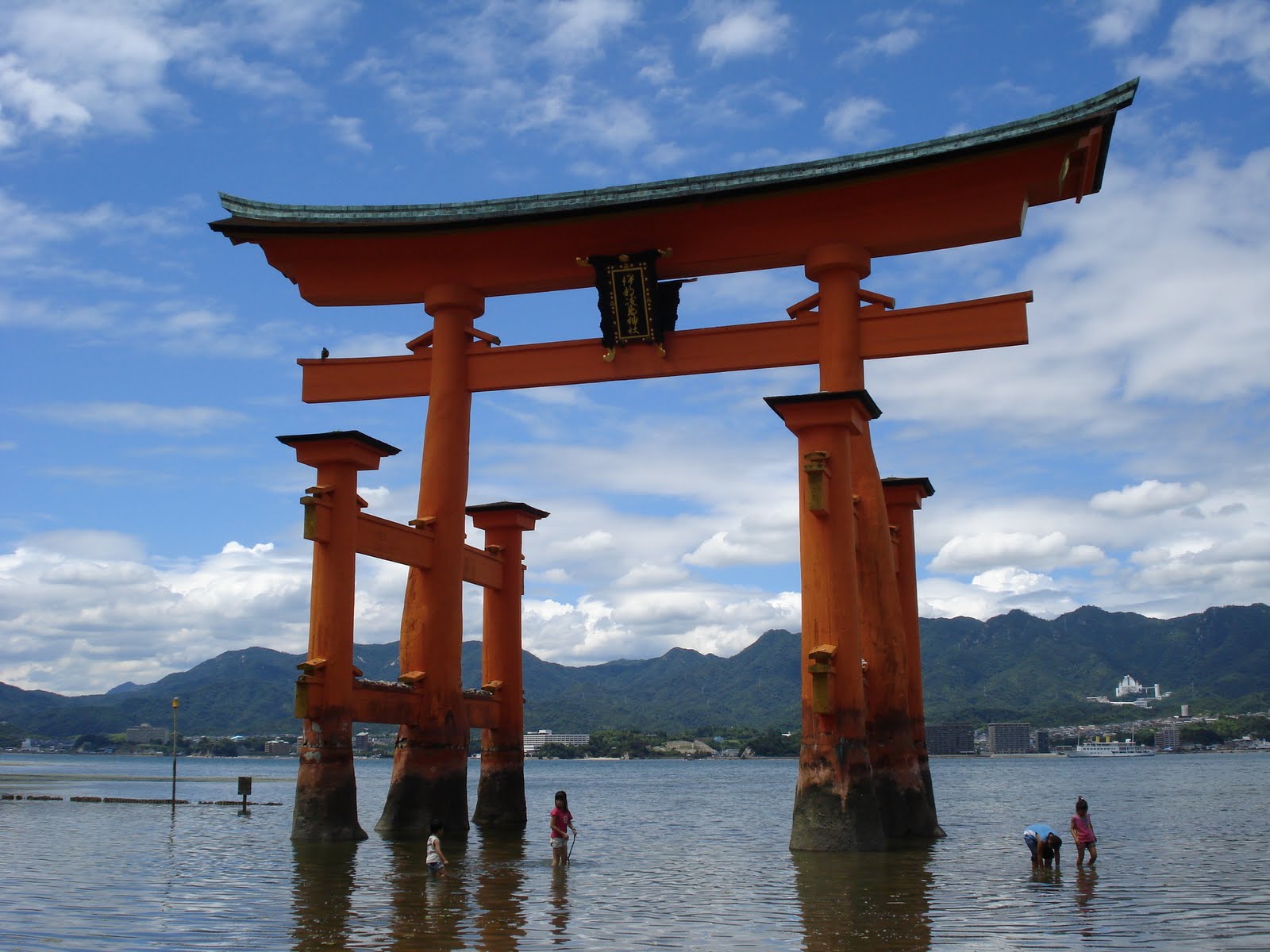

O-tori, big gate, in Miyajima island near Hiroshima. The gates are usually built outside shrines, but as this whole island is considered sacred, the gate is built in ocean! One of the most scenic places in Japan.

And back to Tokyo (in a Willer-travels bus,
direct Hiroshima-Tokyo)
"We shall not cease from exploration
And at the end of all our exploring
Will be to arrive where we started
And to know the place for the first time." T.S.Eliot

Wakkanai in northern tip of Hokkaido, and Kagoshima islands down south (and Okinawa of course) is next ...

Thank you Japan!

Wednesday, May 12, 2010

Time for frugality!


One of the early quotations heard from elders who have "seen the world":
Spread your legs to the extent your blanket allows!
(or else..., I inferred, you might get frost bite. On the serious side, this means, spend within your means)

But looking around, governments of today lost track of how big their blanket is, they are embracing the satanic spirits of debt and loans with open arms, mindless of that day in winter when the frosty days of severe-winter strikes and the blanket size turns out to be that of a handkerchief.

I am flabbergasted looking at the current national debt of Japan.
882.92 trillion Yen!! This increased by 36 trillion Yen over last year alone.

What is worse, this debt is 180% of GDP!
Economists say that in spite of this, the JGB (Japan government bonds) remain stable because of significant public reserves. Yet, I mean - $9.45 trillion! How can you not panic!!


And what measures do you see the government taking? Plan/policies for future direction?
There are few committees here and there for a "austerity drive" within the government. But when you are handling this mammoth of a debt, cutting few billion Yen is similar to trying extinguishing the forest fire with a garden hose. And forest fire it is, of proportions never handled before!


On the other hand, Japan continues to be one of the biggest lenders on the world stage, to the tune of billions of $ every year, through its direct channels JICA, JSDF, JBIC and indirect ones such as ADB and World Bank. This significant outbound flow of money might even be labeled by some as a Ponzi scheme of gigantic proportions.


The need of the hour is practicing frugality at root level for any lavish spendings, making everyone aware of the problem at hand and tackling it together. Gather the think-tanks and start formulating strong fiscal policies to tackle this problem now rather than wait for a J-Greek crisis hitting the shores...

Many want to spend their way out of the crises. But if strategies are not formulated wisely, even the handkerchief will vaporize, as does wisps of mist when the sun comes out.

Some observations on the debt statistics:
  • The debt is ~7 million Yen for every person(including kids) in Japan. And it is growing!
  • Emptying the complete Japan-post savings deposits will pay only 1/5th of the debt
  • If you take out the total currency in circulation in Japan, still the debt cannot be paid off
  • With the amount of debt, you can get a tuna-mayo onigiri 「ツナマヨおにぎり」 for every person in Japan, everyday, for next 108 years (~200Yen for one onigiri) 


    Sunday, May 9, 2010

    CC Lemon - Oxford batch of 2011


    So I started getting to know my future classmates. Interestingly enough, until now, of around ten people from Japan who have been offered a place at Oxford, ~50% are foreigners.

    To give some idea about few of profiles:

    Japanese
    More than five years work experience with a Japanese Bank, M&A advisory.
    He looks forward to the Oxford experience.

    Australian
    Works for a placement consulting company (executive search).
    Aims to run his own consulting company post MBA.

    Japanese
    More than ten years work experience with a Foreign bank. Product management.
    His objective is to gain further expertise in leadership skills and progress in his field.

    Indian
    Technology senior analyst at a leading investment bank. More than eight years experience.
    Has the objective of transitioning from technology to business side.

    Chinese
    Accountant in back office of a leading investment bank with more than five years experience.
    Going to Oxford for a life-changing experience.

    In our facebook group, I can count 15 nationalities already (two more rounds of admission are pending before 2011 batch starts). So there will be more. 
    Last year's class has students from 48 countries!

    Many of them are married and will be living in Oxford with their spouse. 
    The wives of my seniors had only good things to say about their experience at Oxford - how fully engaged their schedules were, traveling, socializing and few even taking up courses to study.

    If you have noticed, the school chooses people who are already at a certain level of maturity and can be a good fit for the overall-class. Average age is 29-30. 

    Having said that, there are also few younger people in the class (with experience of 2-3years). Most of them I talked to have an entrepreneurial flair. They are either inheriting family business or plan to roll out something on their own. Also,  many social entrepreneurs, who plan to work with NGOs or launch their companies which will benefit the mankind.

    The Japanese I have talked to, regarding their admission experience, told me about the challenge on TOEFL. It seems that the high requirements for TOEFL score is an obstacle for many people from here.

    But if you have studied from, say, an University which teaches in English or have worked abroad for a long time enough that you feel your English is fluent, you can write to the admission office requesting for your application to be accepted without TOEFL exam. Of course, your GMAT (specially the English section), essays and application should be strong enough for them to accept this request.

    In case you are reading this, then you already have the curiosity.
    In addition, if you have the passion, zeal and enough sense of adventure, then go for it! 
    Why should a small hurdle like TOEFL stop you? After all, Thomas Paine has said "What we obtain too cheap, we esteem too lightly."


    P.S. 
    In case you are wondering why the post is CC-Lemon, it is tangy and bubbly drink; at the same time, you know it is healthy -- will do you good. I have a similar feeling while socializing with my diverse and elite group of classmates. The feeling of drinking CC-Lemon(^^)

    Tuesday, May 4, 2010

    Oracle edging out others

    The company has been in a heavy acquisition spree since 2005, the heaviest of those being Peoplesoft ($10.3 billion), Siebel ($5.8 billion), Hyperion ($3.3 billion) and BEA ($7.2 billion).

    But none of those have seen enough respect from Mr. Larry Ellison as the latest one - Sun Microsystems ($7.4 billion).


    This respect can be seen in the latest sail, oops, "wings" of boat used by Larry's team in the America's cup 33rd race! What popped out loud is the change in logo. None of the other acquisitions have found a place in this boat. It might be that Oracle had just started flexing its muscles at these races few years back and now it's one of the leaders of the pack!

    However, old boats (2008 and 2009 too) had the logo of BMW and Oracle in equal proportions. This year I can see only Oracle and Sun prominently :) BMW still retains some tiny space in the hulls, which might be gone next year. 
    This is a state of art boat, a complete evolution and one would have guessed that BMW would want to keep its fair share of publicity...

    Is it a temporary arrangement? Or is Ellison putting in most of the $10 million (estimated design and construction cost), after all it wasn't a good year for automakers.

    Thoughts? Oracle and BMW marketing strategists?

    Monday, May 3, 2010

    Nokogiriyama - day trip

    Emerging from under the weather. After staying indoors for 2-3days, what better way to break the routine than a day trip.

    Nokogiriyama (Mt. Nokogiri) is in Chiba prefecture, very close to Tokyo, Japan.
    Chiba is one of the lesser known places for tourists, even if it is probably the first place they see after arriving in Japan (Narita airport is in Chiba).

    Surprisingly, not many locals know about Nokogiriyama either! Notwithstanding that the great Buddha of Mt. Nokogiri is more than two times that of Kamakura, the much more popular destination.

    As I wanted to see the Aqualine (which has a 9.6Kms undersea tunnel built at the cost of ~USD11 billion, but didn't get much used due to high toll-fares). So I took the bus.

    From JR Tokyo station, if you take Yaesu central exit, cross the road and walk to your right for 2-3mins you'll find a NTT Docomo shop. You can get bus for Kisarazu from here. One way fare is 1300Yen and this bus goes via the aqualine.

    Once you alight at JR Kisarazu station, take the Uchibo line to Hamakanaya station (570Yen for the regular train, extra for express).

    From there you can take the ropeway to Mt. Nokogiriyama (900Yen two way).

    But that's not what I did. Being the "born explorer" (chuckle) that I am, 'alighted at the next station from Hamakanaya, called Hota (little more than Hamakanaya, 650Yen). From there I walked towards Mt. Nokogiri. A mountain driveway takes you to the entrance. Entrance fee is 600Yen which covers the whole area.

    Ask for a English map. There are three observatory points in addition to the attraction of Buddha statues (One big sitting stone-statue, ~1500 small stone figures) and you have to ascend, descend multiple times, checking your map, to cover all of them in time.
    Lot of steps to be climbed.

    The sitting statue of Great Buddha, at 31.05 mtrs, is said to be the largest in Japan!
    Kamakura Great Buddha is 13.35 mtrs and Nara Great Buddha is 18.18 mtrs (got this from the pamphlet they handed over).

    The views of the ocean and villages below are splendid. 
    I could see the Tokyo bay area, but even if it was a clear day, couldn't see Mt. Fuji!

    The other main attraction of this place is Ruriko Observatory. A protruding piece of rock from where it is scary to look down. Known as the "jigoku nozoki", looking into hell. This is very popular and the most crowded of all spots, maybe people are curious what they will look at after they die ;-)


    I liked the huge stone carving of Buddha (which I would have missed had I not decided to hike on my way back too!). Hikers will like the trail from Mt. Nokogiri to Hamakanaya station as it is more through the woods and gives better experience than walking on the driveway! To enter the trail, you have to look for the "Hundred-shaku Kwan-non" on the map. This is the place where the big-carving is too...
    Reminds me of a scene in Tomb-raider!

    It was ~1hr hike back from this place to Hamakanaya station (I walked down to the beach close to the station too, but apart from the nice ocean view, the beach itself is unclean).

    Kanaya port is close to Hamakanaya station and for people who want to enjoy a ferry ride can take one to Kurihama port (and get train to Tokyo from Kurihama station). Time-wise, this should be fast too, maybe almost the same as if you take the bus from Kisarazu which goes via aqualine. 

    I hopped on 3.30pm Boso-express at Hamakanaya station 'coz it looked exotic (and had "view-train" written on it). Fare to Tokyo is 1750Yen (+900Yen express charges). Makuhari was on the way and I was half a mind to get off as plenty of daylight was remaining, but after all the hiking, the legs voted against it. So that's for another day...

    Ah! don't forget to take packed lunch and snacks..

    Lack of restaurants and widespread advertising might be the reasons for Mt. Nokogiri not catching on popularity. Good for travelers in a way - no mad rush :-)

    Sunday, May 2, 2010

    A Petition to Japan government

    Dear Policy Makers,

    You are grappling with a steep debt-GDP ratio (which, if not for the public savings, would have taken the country down by now), global competitiveness and above all a drooping morale and a lack of ambition amongst your young. 

    I would kindly like to bring to your attention one single greatest factor which you can directly control:

    Alcohol Consumption!

    Boozing is rampant in your country and drinking culture has seeped deep in the society. 
    Office workers' most common routine is to have a drink or two before returning home. School goers (in addition to sneak binges) are eagerly waiting for the legal age of hatachi (20) before they can jump on the bandwagon too! 

    Ladies are not lagging behind either and why should they, after all this is the age of no discrimination... 

    In my stay of 4 years, I have met only three people who say they don't drink; one of them due to medical reasons.

    *This graph is from www.nationmaster.com. Says the whole story!

    (*per person per year)
    And this is one country where liquor is most easily available. Lines of izakayas (local pubs) in every market, vending machines selling beer, wine shops, and most important, the 24hour convenient stores - all of which seem to be selling alcohol. 

    Oh, and never in all these years have I seen any of them asking for ID!

    You will say that spirits industries are one of the oldest, strongest and driving the economy too. It is a argument that with a revenue of ~USD14 Billion, Asahi Breweries donated ~USD 2.5 million to charity last spring and intends to distribute another amount this year to prefectures (government) according to "sales volumes". 

    However, this is just the perfect incentive given to the government to not to intervene with growth and marketing plans.

    In addition to the reasons of looking at a future with forward thinking and decent society, you have to control the sale and advertising of alcohol because:

    1) A parent acts as a role model for her children. But when parents return home in a drunk state, how will the children look up to them?

    2) The negative impact of regular drinking on health is well known. Research has also shown that drinking kills brain cells. Think of how much brain-power you are loosing as a nation.
    A few generations down, children will have much lesser cognitive abilities (might even get significantly dumb)! Think who will drive your innovations, write haiku and shodou, and run the government then?

    3) In spite of a strong alcohol lobby, other nations have maintained resistance to make it so widely and easily available. By buckling in to the pressure from lobbies of such industries you are losing a competitive edge globally. 

    4) Spirits are proven to have a negative sexual effects, which impacts the birth rate too. So promoting alcohol is counterproductive to your policies to promote the birth rate.

    For the people who want to quit, it is next to impossible to do so in Japan. You travel in the subways or watch TV - one in five (if not more, at least 10%) of the commercials are for alcoholic beverages (Asahi, Kirin, Sapporo, Suntory etc.). Even in prime-time, when many children are watching!
    You go to office parties and will immediately feel out of place if you refuse a drink. 
    You almost become a social outcast if not drinking!

    So raising this petition for:
    1) Restricting rampant advertising of alcohol in internet, mobile, print-media, TV, fliers and hoardings.
    (Stop prime time advertisements of alcohol; Restrict other alcohol commercials to less than 5%; Aim for similar restrictions on alcohol industry as it is on tobacco industry)

    2) Restricting sales channels to make it difficult to buy. At least from the convenient stores and vending machines.
    (Stop alcohol sales in 24hr convenient stores; Make compulsory Taspo like card for purchasing alcohol)

    Trust me, those who want to drink will find a way to their jokki and nama. But these measures will bring a gradual impact on the generations to come and you will slowly move towards a lesser drinking and more healthier society.

    Else, it will be interesting to see the strength of the economy propping itself on the pillars of beer cans and wine bottles.

    - A Concerned Resident

    Saturday, May 1, 2010

    For Saïd aspirants...

    Benefited lots from various forums/blogs and thought of putting in few lines myself for future aspirants, on my journey to hearing the musical honey-laden words - 
    "you are admitted":

    By mid 2009, I had come to realize the need for me to get back to school and gather the necessary tools and techniques to come back and employ in the industry.

    Step 1: GMAT - I started preparations during August. Official Guide, Manhattan guides/tests and Princeton reviews. If you are preparing by yourself and have been out of touch with such competitive exams for a while, plan for at least 3-4months of studies and practice. 

    The best thing I did was to join www.gmatclub.com early on during preparations. Very valuable community support and a plethora of resources.
    Step 2: Identify schools - I had made up my mind to study in Europe. Which helped narrow down the scope. Oxford was the first choice. While choosing the schools to apply to, I looked at what the school has on offer and how close is that to my requirements and desires. Looked at syllabus, faculty, teaching methodologies, projects, networking, international representation and reputation (+ranking of-course). 

    These two youtube videos will give a good idea on SBS, for people not already familiar:

    Oxford University 


    Saïd Business School 


    (more can be found at http://www.sbs.ox.ac.uk)

    In addition to a management education, I was looking for an vivid experience, towards which Oxford (SBS itself, the college - every student has to join a college too, and the University) simply has so much in the form of sports, societies, events and so forth.

    [On the lighter side, looking at the number of pubs and parties in Oxford, I expect to get an additional MBA (Master of Beer Assessment) when I graduate!]

    At the same time, I knew that it is going to be tough to get into the school of my choice, given that I belong to the most well-represented demographics and thus was prepared for putting in super-extra efforts in further steps.

    It is important to time your application. Advisable to be in round-1 or round-2. But then, if you feel that you are not completely ready and some more work can improve your chances, do not rush in.

    Step 3a: Essays and CV - Finished the CV first. Got a friend to review it (Had to get 5pages trimmed to 1 page. most of the schools have it mandatory). I took up one school's essays at a time. This is very important part of your application and after GMAT, the most time consuming. It took me 2-3 weeks for essays of one application. I reviewed it as many times possible. Also requested a friend of mine to read it and must have modified each essay ~5-10 times. If you have the spare cash to get professional help for proof-reading, that takes some load off the shoulders too. 

    SBS gives topics (which are same for past few years) for two essays. Good thing here is that the word-limits are not miserly, on the other hand they are vast and cover a lot of ground:

    1) Explain why you chose your current job. How do you see your career developing over next 5 years? How will an MBA assist you in the development of these ambitions? 1000words
    2) Which recent development, world event or book has most influenced your thinking and why? 2000words

    I gathered that SBS is looking for mature candidates (thought-process wise); after all it's a place where you "think rigorously and grow intellectually". 

    Step 3b: Recommendations - The school asks for two recommendations. I asked my current boss and a previous colleague to act as a referee. I informed them 4weeks+ in advance and called/discussed about my application highlights and the essay details. At the same time I asked them to be very open and fill-in their true thoughts. 
    I'm glad to have given them enough time as one of them gave the feedback that it is a multi-page form, very thorough. I don't get to see what they'd input.

    Was in time for the R2 deadline.

    Step 4: Interview - It took ~1 month from the time I submitted the application to the declaration cleared candidates. It is an excruciating wait. People have recommended to go and attend personal interview (if possible, plan for a open-day where you get to meet current students, faculty and maybe attend a class too). 

    Unfortunately, due to work schedule and what-not, I couldn't make the trip. SBS gives an option of telephonic, skype and personal interview. I chose telephonic because it was one of the early slots available. 
    Unlike other B-Schools, the Oxford interview is more structured (at least I felt it to be so), and is taken by faculty or sector-consultant (who is assigned, I think, to match your work-background). 

    In addition to "why MBA", "why SBS", quite a few behavioral questions... "negative qualities", "leadership points" and one psychoanalytical-type question, something of the kind "if I give you the power to be anybody for a day, who would you be and why". This is not the question I was asked though, but was on similar lines. I regretted not being able to make for personal interview as on reflection I had this feeling that I could have made some of my points stronger in a face-to-face discussion.

    Another excruciating ~one-month wait before the results. Patience is one of the managerial virtues too :-)
    I saw the email during transit and the next leg of journey was in high-skies in every sense. 

    One big THANKS to the support from folks at home and the constant help of a dear friend to make it happen.


    Step 5: Funding and Scholarships - Within a month of getting the offer, I need to secure the place by paying a deposit of GBP4,950 which is later offset against course fee.
    SBS fee is GBP33,000, college fee GBP3,000 and living expenses ~GBP12,000 (increases every year). So I need to provide a financial guarantee of ~GBP48,000. Including airfare and travels, I reckon the total tab for me to be ~GBP50,000 for the one year full-time MBA.


    Scholarship is another of the reasons you would want to apply in R1. There are SBS scholarships, college scholarships (see individual college's website; 38 colleges) and University scholarships, one can apply to.


    For people who are starting early and have more than one year for their application, start your search for outside scholarships in parallel to Step1 of GMAT (depending on place, there are options with World Bank, regional governements etc. which needs applications well in advance).


    Step 5 is not the final one for Oxford as there is the process of getting into a college after you get admitted to SBS (though I haven't heard of any case yet, where all of the colleges have refused admission to a candidate resulting in cancellation of SBS offer!) .
    Yet another reason to be an early bird (R1) . The popular colleges get filled before R2, R3 selections complete.

    Choosing a college is another part of the Oxford experience, even before you start there, very unique, very.. "Magical!"


    Good-Luck to all applicants!